Sat, November 7, 10:10 AM EST
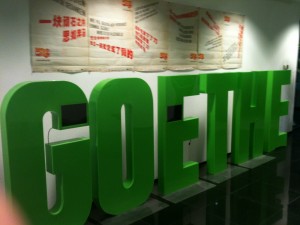
It has been a good week of exchange and discourse about the work at the http://www.tanzkongress.de/ in Hamburg.

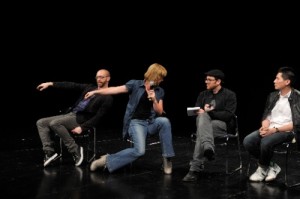
Steve Turk and I did a lecture demonstration and workshop on Synchronous Objects yesterday focusing on what is happening now with the project coming back into the studio and into classrooms (in dance and architecture).

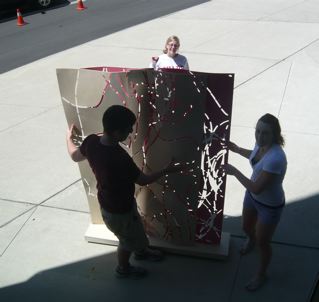
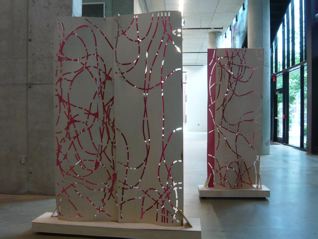
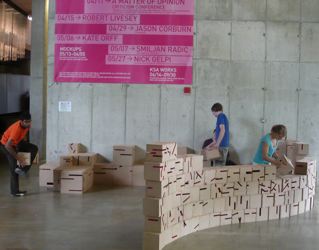
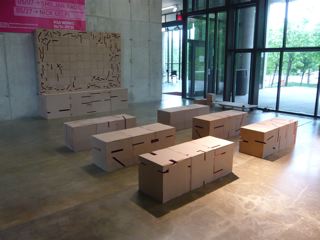
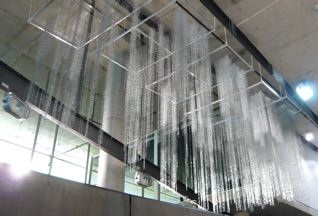
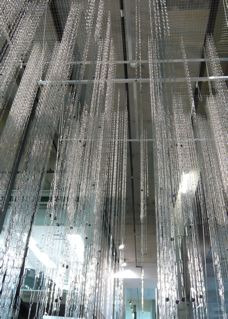
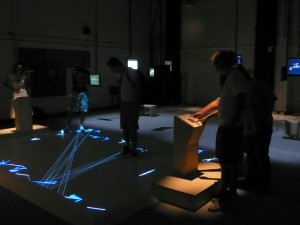
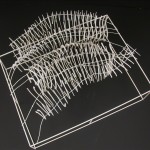
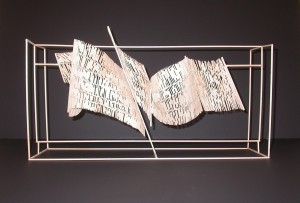
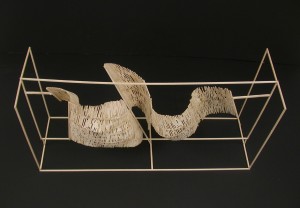
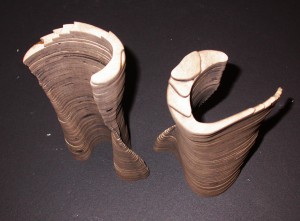
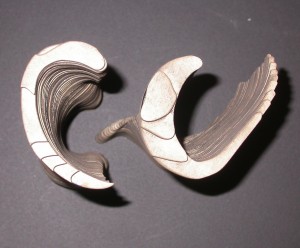
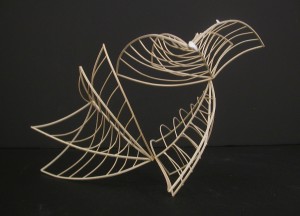
Ohio State architecture students working on installation projects using synchronous objects as a resource.
More on curricular developments at Ohio State next week.
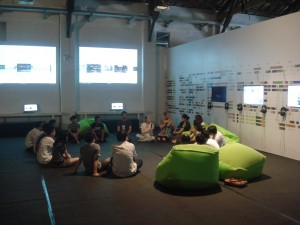
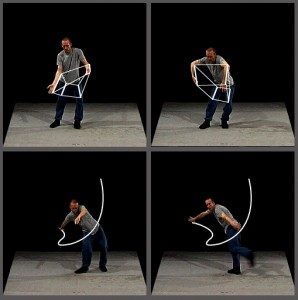
Here in Hamburg it was a pleasure to take a step beyond the lecture format this week and to share with 20 workshop participants a movement laboratory based on the systems in “One Flat Thing, reproduced” and the process we experienced in the creation of Synchronous Objects, namely the iterative and reflexive, analytical and creative scoring of the dance. We did several simple improvisations that allow the group to construct networks of relationships (cues) and to experience forms of relationship in motion (alignments) without any dance training.
I’ll post a lesson plan on the blog some day soon and I invite teachers out there who are using the site in their classrooms to share your ideas with me as well and here on the blog.
Hamburg by the way is a beautiful city with a small town feel and big city culture. It must be gorgeous in the summer. The Kampnagel where the conference is held is a fantastic renovated industrial facility, one of many in Germany. -Norah

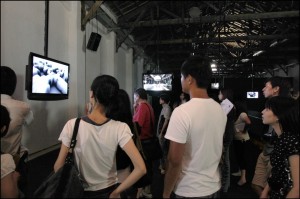
Kampnagel, Hamburg, Germany
Fri, September 25, 8:08 AM EDT
One of the great delights of having Synchronous Objects out there is that we hear from students who are exploring the site and asking questions. We’re considering developing this part of the project more through participatory learning initiatives. In the meantime we’re enjoying hearing about the emergent grassroots curriculum development that is taking place and we encourage you to get in touch with us with your questions, ideas, or needs. The latest email we received from from a geography student finishing her undergraduate work at a University in Canada. She is writing her honors paper on our project and as an initial inquiry wanted to know how we gathered our spatial data for the Movement Density object and others. I thought this might be of interest to others so I am posting Maria’s reply here in the blog:
“We gathered our spatial data by tracking one point on video on each dancer throughout the entire dance. We used both the front and top view of the video to track this using special purpose software that we developed in house. This data was then organized as x,y,z locations over time per dancer. Then we provided this data in a number of formats, for use in visualization. We would reformat the data using code, to match whatever the visualization required. The Density surface maps in the Movement Density object were then created by reading in this data and generating it for every second of the dance. The geographers then output the results in a frame by frame basis, at 25fps.” -Maria Palazzi
And a note on interdisciplinary process: it was never this neat or orderly. In our experience, interdisciplinary collaboration requires a high tolerance emergent structure. The real discoveries in interdisciplinary knowledge transfer happen in the subtle moments of understanding that come within the chaos of working together, not unlike counterpoint. Our collaborators in Geography, Hyowon Ban and Ola Ahlqvist made 100s of different kinds of maps and we looked at all of them together and discussed them at length. We discussed the different interpolations and how they either revealed or obscured the data. We looked a issues of color and transparency. We spent time unpacking our terminologies and carefully defining the exact use of words like spatial data and attribute data. We discussed the issue of creating data from qualitative sources and shared differing disciplinary perspectives. But more than anything we came to the room each time with a healthy respect for the differences in our ways of understanding and our ways of making and doing and a sense of confidence that there were opportunities for agreement and interesting new alignments.
Keep your questions and interests coming, we love hearing from you.
Norah
Mon, July 27, 14:02 PM EDT
As we prepare to present Sync/O at SIGGRAPH this week, we’re thinking about pathways through the site and how we guide people when we present on the work. We most often recommend two approaches:
1. Discovery-based pathway:
By design, there are many ways into the site and therefore many ways into understanding this dance and one great way to approach it is just to beginning clicking on images that interest you and follow your own path of discovery. As you do so, notice that every object includes a PROCESS CATALOG tab (on the left hand side of your screen). Continue Reading
Fri, July 10, 16:04 PM EDT
We are hard at work during the month of July refining the site and making some small additions. In the coming weeks look for some upgrades on the popular Counterpoint Tool and in our full score interface called The Dance. Also look for more ways to interact with and share content. And do let us know if you’re finding oddities or bugs.
We’ve also been sharing the project a lot at interesting venues and will continue to do so this summer including:
Spring Dance 2009, Utrecht, The Netherlands “Inside Movement Knowledge”
Sadler’s Wells, London, UK “Focus on Forsythe”
PACT Zollverein, Essen, Germany “Exploration 09″
Society for Animation Studies Conference, Atlanta, USA “The Persistence of Animation”
SIGGRAPH 2009, New Orleans, USA “Information Aesthetics Showcase”
and more…
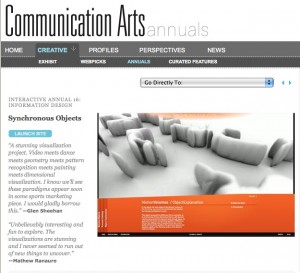
We’re also happy to be featured on one of our favorite sites, visualcomplexity.com

Sat, June 27, 15:03 PM EDT
Mon, June 8, 9:09 AM EDT
Another great contribution from graduate student Lily Skove:
At the Ohio State University, The Advanced Computing Center for the Arts and Design (ACCAD) is a unique space for the convergence of distinct fields. Perhaps “collision” of distinct fields would be a more apt description, as “convergence” suggests easeful assimilation. Collaboration as collision necessitates the full force of each fields’ identity, traditions, and expertise entangling to create something new, and this is how I would describe ACCAD’s latest conquest, Synchronous Objects for One Flat Thing, reproduced. Working as a student on this project gave me the unique vantage point of observing and engaging experts at work in cross-disciplinary investigation. Continue Reading
Tue, May 26, 9:09 AM EDT
Matt Lewis is a computer scientist and collaborator on Synchronous Objects. His work in generative drawing was an inspiration for the generative drawing tool available on the site. If you have not played with this tool yet, give it a try, it uses data from the dance to drive the motion of the “paint brushes” and create interesting animations and ultimately drawings. Let us know what you think! –Norah
Here are some thoughts from Matt:
MATT: In addition to making choreographic concepts more comprehensible to other disciplines, we are very interested in ways in which choreographic knowledge is useful in other contexts. Exposure to such ideas should provide new ways of seeing, communicating, and evaluating relationships among elements in complex dynamic systems. Having not had much exposure previously to contemporary dance, I now have a much greater awareness of its complexity and breadth of conceptual material. It’s intriguing to me that I see much richer relationships between dancers and their movements than I had before being introduced to these concepts. Continue Reading
Mon, May 11, 12:12 PM EDT
Mara Penrose, an MFA student, and Hannah Kosstrin, a PhD student in the dance department at the Ohio State University, offer insights about Synchronous Objects from the perspective of Labanotation and dance history in a recent interview with graduate student Lily Skove.
Lily Skove: Can you speak to your interest in Labanotation in relation to Synchronous Objects?
Mara Penrose: Systems of annotation represent the movement they describe. Therefore, dance notations need to be specific to the piece itself and the intended audience. Continue Reading
Thu, April 30, 10:10 AM EDT
I have invited collaborators on the project to periodically contribute to the blog describing their roles and interests in relation to Sync/O. This post is written by one of our graduate students in dance and tech, Lillian Skove:
“Engaging with Synchronous Objects as a choreographer, I was very interested in how choreographic thinking is a way of knowing that offers new insight into other fields from geography, to computer programming, to architecture. I was also interested in the ways that other fields shed light on my own choreographic practices and turn my understanding of choreography inside out. In the process of creating I seek to undo what I think I know choreography is so that I can be open to inventive ways of working. Interacting with the Synchronous Objects website is a chance to re-think what choreography is, from a series of actions, to an example of counterpoint, to a study of the responsibilities and dependencies among a group—and the list goes on.
Up-ending my assumptions of what choreography is has several practical consequences that are evident as I create in the studio. Continue Reading
Thu, April 30, 10:10 AM EDT
After being in Europe for a week and sharing the project at Spring Dance and in the Sadler’s Wells “Focus on Forsythe” festival of events, our interest in sustained dialog about the project continues. What happens after the initial introduction? Which objects draw different people in which ways? We hear often from choreographers that the counterpoint tool captures their interest. It was great to hear in london from people in the audience who already knew the project, like professor Sarah Rubidge who shared her interest in the generative drawing tool (one of our favorites). It was also nice to share the video abstraction tool with a young dance / tech presenter from Norway who wanted to explore patterns in her own work. We’d love to know more. Be in touch here on the (blog) or on twitter, we tweet collectively as https://twitter.com/SyncObjects and I tweet as nzshaw.
—Norah
Recent Comments