We are focusing our blog on educational uses of Synchronous Objects for the next few weeks. So far we have posted examples of courses at The Ohio State University but we have also begun to solicit contributions from educators in other institutions who have either written publicly or contacted us about their use of these materials. This week we feature a post by Kristin McGuire who is “a dancer and dance lecturer interested in anything but dance.”
More information about her work can be found at:
www.kristinmcguire.com – Latest Project: www.theicebook.com
enjoy – nzshaw
“Synchronous Objects was the subject of the second lecture within a trilogy, which developed ideas from the “choreographic algorithm” to the “choreographic object” to the “choreographic construction”. All 3 lectures revolved around the work of William Forsythe.
The lecture series started with the analysis of Improvisation Technologies, which provided a rich database of dance operations and instructions. I found that they could be used in order to define a choreographic algorithm and as such create a dance piece. An algorithm is defined as a precisely described set of instructions.
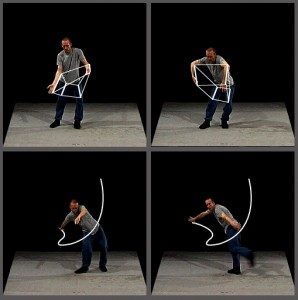
The 3rd year dance students were asked to “fax” a ballet creating a simple choreographic algorithm based on the instructions/operations shown in the Improvisation Technologies CD. The remark of the architect Britta Callsen who had used Improvisation Technologies as an inspiration for her own project led me to my third lecture titled: Dance is Architecture in Motion. About the shared vocabulary of seemingly opposite art forms. Choreography and architectural planning as fundamental principles of organisation. Her remark is very insightful when it comes to analogies between architecture and dance:
“As an architect I sit in front of my computer, I click through the different menus of the CD and I get overwhelmed by a glaring similarity to the interface of my CAAD program.” (Britta Callsen 1995) When I asked her to name the similarities she responded: “With the CAAD program I construct a building with lines, polygons, circles which are basic geometric figures. I click the command ‘line’ to define two points and I draw a line between them. In order to view it in the right position I take the line and turn, twist, flip it in the virtual space. It is the same operation Forsythe demonstrates on his CD when he describes the relationship between parts of the body in motion.”
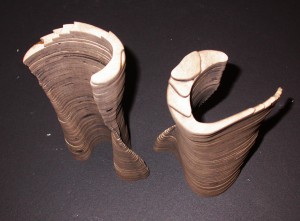
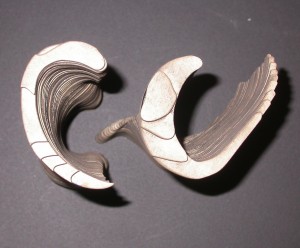
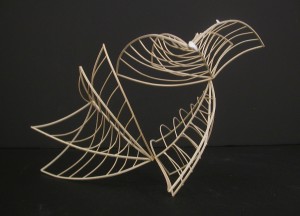
During this lecture the students were asked to develop a choreographic construction using orthographic drawings of a building (see image below). As they were keen to “manifest” those constructions in a dance piece they created work based on those constructions, which turned out to be very exciting material.
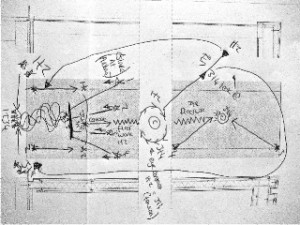
Example of a choreographic construction
More of the drawings as well as the dance material can be viewed on
http://advanceddancetheories.blogspot.com/.
Synchronous Objects was the subject of the second lecture in between the two I have just described. The idea of the choreographic object as Forsythe describes it seemed to sit well in between a choreographic algorithm – a well-defined yet clear and simple mathematical structure – and a choreographic construction – a complex, multi-layered, 4-dimensional construction of kinetic events.
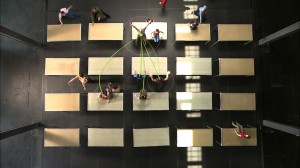
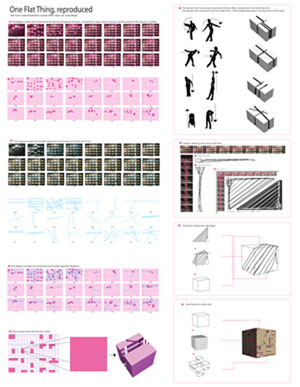
Synchronous Objects was a real eye-opener to my students who said that they had never come across anything like that. Since knowing this tool they take their dance pieces apart and reassemble them on timelines; they develop cueing systems for their dancers; they look at the dance floor as a map etc. Since looking at the science inside One flat thing, reproduced they have become researchers of their own creative practical work.
Apart from the impact that Synchronous Objects had on my students I can say for myself that it clarified and thus resolved a contradiction of concepts about dance in my own mind. It made me realise that dance has left the dramatic performing arts world, which is still based on narratives. Choreography in my eyes is DESIGN as opposed to performing arts and it would be worth piloting an academic project based on a design syllabus rather than on a performing arts/drama syllabus.
Who is up for joining me on that?”
– Kristin McGuire





Recent Comments