Uncategorized Category

Synchronous Objects in Hamburg

It has been a good week of exchange and discourse about the work at the http://www.tanzkongress.de/ in Hamburg.
logo_tanzkongress

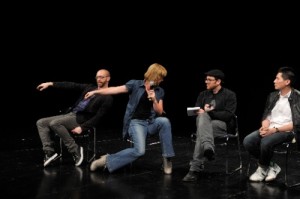
Steve Turk and I did a lecture demonstration and workshop on Synchronous Objects yesterday focusing on what is happening now with the project coming back into the studio and into classrooms (in dance and architecture).

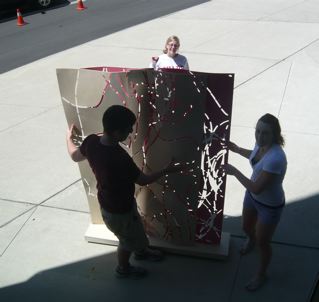
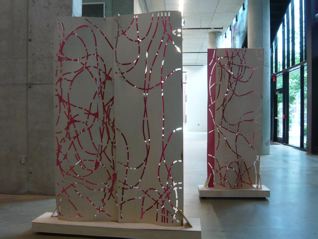
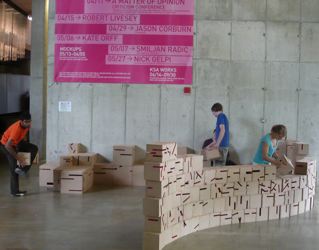
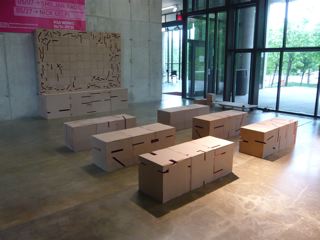
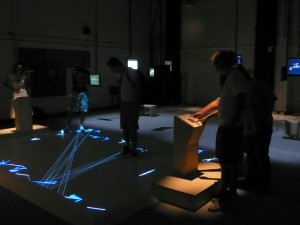
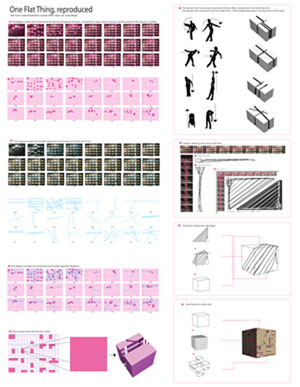
Ohio State architecture students working on installation projects using synchronous objects as a resource.

Ohio State architecture students working on installation projects using synchronous objects as a resource.

More on curricular developments at Ohio State next week.

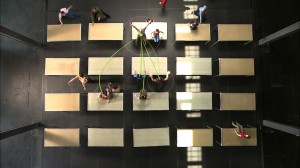
Here in Hamburg it was a pleasure to take a step beyond the lecture format this week and to share with 20 workshop participants a movement laboratory based on the systems in “One Flat Thing, reproduced” and the process we experienced in the creation of Synchronous Objects, namely the iterative and reflexive, analytical and creative scoring of the dance. We did several simple improvisations that allow the group to construct networks of relationships (cues) and to experience forms of relationship in motion (alignments) without any dance training.

I’ll post a lesson plan on the blog some day soon and I invite teachers out there who are using the site in their classrooms to share your ideas with me as well and here on the blog.

Hamburg by the way is a beautiful city with a small town feel and big city culture. It must be gorgeous in the summer. The Kampnagel where the conference is held is a fantastic renovated industrial facility, one of many in Germany. -Norah

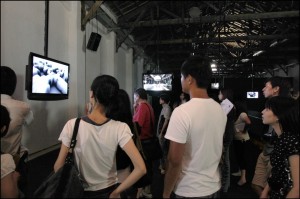
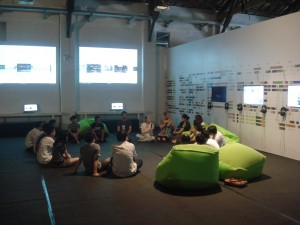
Kampnagel, Hamburg, Germany

Kampnagel, Hamburg, Germany

Share/Save/Bookmark

Synchronous Objects in the classroom

One of the great delights of having Synchronous Objects out there is that we hear from students who are exploring the site and asking questions. We’re considering developing this part of the project more through participatory learning initiatives. In the meantime we’re enjoying hearing about the emergent grassroots curriculum development that is taking place and we encourage you to get in touch with us with your questions, ideas, or needs. The latest email we received from from a geography student finishing her undergraduate work at a University in Canada. She is writing her honors paper on our project and as an initial inquiry wanted to know how we gathered our spatial data for the Movement Density object and others. I thought this might be of interest to others so I am posting Maria’s reply here in the blog:

“We gathered our spatial data by tracking one point on video on each dancer throughout the entire dance. We used both the front and top view of the video to track this using special purpose software that we developed in house. This data was then organized as x,y,z locations over time per dancer. Then we provided this data in a number of formats, for use in visualization. We would reformat the data using code, to match whatever the visualization required. The Density surface maps in the Movement Density object were then created by reading in this data and generating it for every second of the dance. The geographers then output the results in a frame by frame basis, at 25fps.” -Maria Palazzi

And a note on interdisciplinary process: it was never this neat or orderly. In our experience, interdisciplinary collaboration requires a high tolerance emergent structure. The real discoveries in interdisciplinary knowledge transfer happen in the subtle moments of understanding that come within the chaos of working together, not unlike counterpoint. Our collaborators in Geography, Hyowon Ban and Ola Ahlqvist made 100s of different kinds of maps and we looked at all of them together and discussed them at length. We discussed the different interpolations and how they either revealed or obscured the data. We looked a issues of color and transparency. We spent time unpacking our terminologies and carefully defining the exact use of words like spatial data and attribute data. We discussed the issue of creating data from qualitative sources and shared differing disciplinary perspectives. But more than anything we came to the room each time with a healthy respect for the differences in our ways of understanding and our ways of making and doing and a sense of confidence that there were opportunities for agreement and interesting new alignments.

Keep your questions and interests coming, we love hearing from you.
Norah

Share/Save/Bookmark

Pathways through the objects

As we prepare to present Sync/O at SIGGRAPH this week, we’re thinking about pathways through the site and how we guide people when we present on the work. We most often recommend two approaches:

1. Discovery-based pathway:
By design, there are many ways into the site and therefore many ways into understanding this dance and one great way to approach it is just to beginning clicking on images that interest you and follow your own path of discovery. As you do so, notice that every object includes a PROCESS CATALOG tab (on the left hand side of your screen). Continue Reading

Share/Save/Bookmark

Sync/O at PACT Zollverein

Jonathan Burrows and Matteo Fargion
Photo: Jonathan Burrows and Matteo Fargion

Sync/O is part of a symposium this week called Explorationen 09. It is a really interesting group of people and PACT is a great arts center set in the midst of a refurbished wash house for the coal miners who used to make up the majority of the population in Essen, Germany. The architects who did the refurbishing have left the original tiles, mirrors, soap holders, and other features of the space giving it a haunting feeling of uses from the past. Now it houses artist residencies, dance performances (to my delight this week was British choreographer Jonathan Burrows), and symposia focusing on off-beat and interdisciplinary perspectives. Being here has inspired me to (finally) begin working on my book about Synchronous Objects and the creative research methods it required. -Norah

Share/Save/Bookmark

Sync/O, Laban, and Dance History: Student Perspectives

Mara Penrose, an MFA student, and Hannah Kosstrin, a PhD student in the dance department at the Ohio State University, offer insights about Synchronous Objects from the perspective of Labanotation and dance history in a recent interview with graduate student Lily Skove.
Lily Skove: Can you speak to your interest in Labanotation in relation to Synchronous Objects?
Mara Penrose: Systems of annotation represent the movement they describe. Therefore, dance notations need to be specific to the piece itself and the intended audience. Continue Reading

Share/Save/Bookmark

Using and Sharing Sync/o

After being in Europe for a week and sharing the project at Spring Dance and in the Sadler’s Wells “Focus on Forsythe” festival of events, our interest in sustained dialog about the project continues. What happens after the initial introduction? Which objects draw different people in which ways? We hear often from choreographers that the counterpoint tool captures their interest. It was great to hear in london from people in the audience who already knew the project, like professor Sarah Rubidge who shared her interest in the generative drawing tool (one of our favorites). It was also nice to share the video abstraction tool with a young dance / tech presenter from Norway who wanted to explore patterns in her own work. We’d love to know more. Be in touch here on the (blog) or on twitter, we tweet collectively as https://twitter.com/SyncObjects and I tweet as nzshaw.
—Norah

Share/Save/Bookmark

Sync/O at Spring Dance Utrecht

brunobeltrao

This week I’m in Amsterdam sharing Sync/O with a community of dance researchers called the Inside Movement Knowledge network here at Spring Dance in the Netherlands. This very interesting group of embodied thinkers is involved in a large project focusing on new ways of transmitting dance knowledge. They are dance educators, conservationists working in the visual arts on the preservation of installation and performance art works, choreographers, and academics concerned with understanding the nature of “corporeal literacy.” While here at Spring Dance I also had the opportunity to see Brazilian choreographer Bruno Belatrao’s new work “H3″ (he’ll be in London at Sadler’s Wells in May). It is a incredible work of choreographic counterpoint in a very different movement vocabulary than the one you see in “One Flat Thing, reproduced.” Watching the piece I was grateful to have had the training that this project has given my eye, I could see intricate patterns and structural forms in the piece in an entirely different way because of how Forsythe and our work with him has taught me to see alignments. I’m hoping our objects do this for others who explore Sync/O in a shorter time frame than the four years it took us to make the project. I’d be interested to know if anyone out there is noticing the ways that counterpoint and alignments can come into focus in other works and even other phenomena.
—Norah Zuniga Shaw, Amsterdam, NL

Share/Save/Bookmark

Details on the Data

Since they are not easy to print at the moment, we’ll fix this, I’m adding the introductory essays—THE DANCE, THE DATA, THE OBJECTS—to the blog. They are important ways in to understanding what we’re up to with the project. -Norah

The Data:
We now understand the structure of One Flat Thing, reproduced (OFTr) as a form of counterpoint that is created through the interaction of its three systems of organization: movement material, cueing, and alignments. At the beginning of this project those systems had a variety of names, the precise characteristics of which were hard to articulate. It took a collective effort to catalog and interpret the work as a totality. At the center of that effort and understanding is the data of Synchronous Objects.

The process of decoding OFTr was a creative dialog Continue Reading

Share/Save/Bookmark

Details on the Dance

Since they are not easy to print at the moment, we’ll fix this, I’m adding the introductory essays—THE DANCE, THE DATA, THE OBJECTS—to the blog. They are important ways in to understanding what we’re up to with the project. -Norah

The Dance
One Flat Thing, reproduced (OFTr) is an ensemble dance that examines and reconfigures classical choreographic principles of counterpoint. In OFTr counterpoint is defined as “a field of action in which the intermittent and irregular coincidence of attributes between organizational elements produces an ordered interplay” (Forsythe). Three structural systems interact to create the counterpoint of the dance: movement material, cueing, and alignments.

Movement Material
This contrapuntal dance is composed of fixed movement material with some instances of structured improvisation. While there is no set terminology, members of the company most often refer to the different segments of fixed movement as themes. The 25 main themes are repeated and recombined over the course of the dance in their full and partial forms. In addition to the themes and their interpretation, there is a set of improvisation tasks in OFTr that ask dancers to translate specific properties of other performers’ motions into their own. The dancers observe each other and make these translations in real time, producing different results in each performance of the work.

Cueing
The sequence of OFTr is organized by an elaborate cueing system that acts as an internal clock. Rather than following an external musical structure, the dancers collectively determine the flow of the dance as they give and receive cues (aural or visual signals that trigger events). With more than 200 cues in the dance, responsibility for cueing is distributed among all the dancers

Alignments
Essential to the counterpoint of the dance is a system of relationships that the company refers to as alignments. Alignments are short instances of synchronization between dancers in which their actions share some, but not necessarily all, attributes. Manifested as analogous shapes, related timings, or corresponding directional flows, alignments occur in every moment of the dance and are constantly shifting throughout the group. The term alignment emerges from the working practices of the Forsythe Company. Other words the company uses to describe this phenomenon include hook-ups, agreements, and isometries. Within the thousands of alignments in the choreography, approximately 200 can be understood as a subset called sync-ups. These are moments in the choreography when a dancer’s task is to briefly join with another individual or group.

—William Forsythe and Norah Zuniga Shaw, Columbus, Ohio, January 2009

Stats:
One Flat Thing, reproduced
Stage premiere: 2000, Bockenheimer Depot, Frankfurt, Germany
Choreography: William Forsythe
Music: Thom Willems
Source video: 2005, Bockenheimer Depot, Frankfurt, Germany (15 minutes 30 seconds)
Dancers (17): Yoko Ando, Cyril Baldy, Francesca Caroti, Dana Caspersen,
Amancio Gonzalez, Sang Jijia, David Kern, Marthe Krummenacher, Prue Lang,
Ioannis Mantafounis, Fabrice Mazliah, Roberta Mosca, Georg Reischl,
Jone San Martin, Christopher Roman, Elizabeth Waterhouse, Ander Zabala

(c) 2009 Synchronous Objects

Share/Save/Bookmark

Interdisciplinary Voices 1

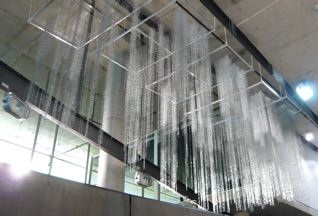
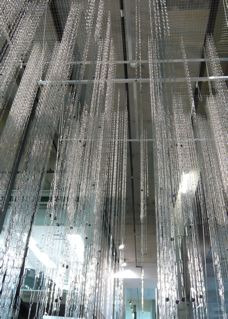
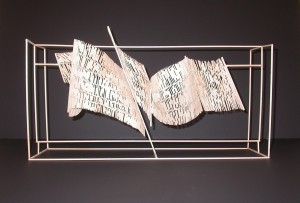
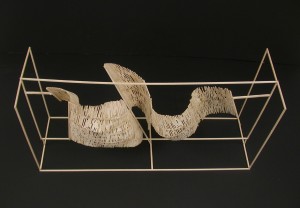
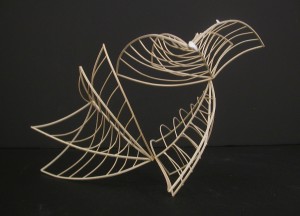
Image from springy thingy by Mark Goulthorpe et al.

Image from springy thingy by Mark Goulthorpe et al.

During our symposium to launch the project we featured the voices of the makers of Synchronous Objects including faculty from several disciplines as well as graduate student and staff researchers. We also invited two special outside guests who are familiar with Forsythe’s work to discuss how they think Synchronous Objects is relevant in their domains and perhaps more broadly. Each of them wrote posts for the e-symposium that you can read in full (see tags or categories to the right). But for this week, I will compile excerpts in shorter posts starting with Mark Goulthorpe. Mark is an architect at MIT who has collaborated with Forsythe in the past. For me, he represents some of the most interesting current trends in architecture including a well-established appreciation for process and performance, interest in surface and event, and a creative approach to the products of the trade. For more ways into these ways of thinking about architecture check out this beautiful blog Interactive Architecture. Many of these projects could be described as choreographic objects.

Mark is a fan of Forsythe’s work and describes dance as relevant to “all areas of cultural production.” He points to Forsythe’s use of “rule-based generative processes” that can be considered “within an historical lineage of similar intellectual projects in different cultural domains (Raymond Roussel/literature, James Joyce/literature, Antoni Gaudi/architecture, Jacques Derrida/philosophy, Paul Steenhuisen/music).” He also suggests that “emergent technologies nurture a new relational aptitude that Forsythe’s work seemingly instantiates.” And he asks us to consider the “expansion of creative praxis from an essentially deterministic and individual mode, that has dominated most established cultural fields for millennia, to one that prioritizes collective creative endeavor.” He finishes by saying “I regard Forsythe as an architect, albeit of the possibility of ballet at the threshold of a new technological paradigm…” This is one of the best things about working on this project with Bill, the way in which other disciplines can recognize themselves in dance/choreography.

For links to more on Mark’s work I like the Floating Points series here. And his more recent project Springy Thingy can be seen here.
—Norah Zuniga Shaw

Share/Save/Bookmark