Dance Tag

Sync/O at PACT Zollverein

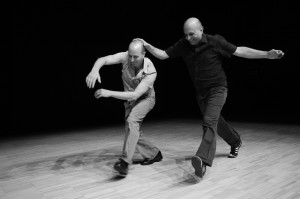
Jonathan Burrows and Matteo Fargion
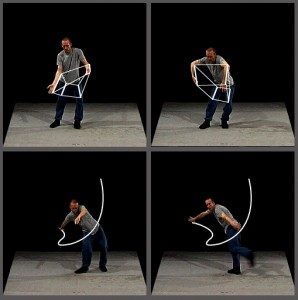
Photo: Jonathan Burrows and Matteo Fargion

Sync/O is part of a symposium this week called Explorationen 09. It is a really interesting group of people and PACT is a great arts center set in the midst of a refurbished wash house for the coal miners who used to make up the majority of the population in Essen, Germany. The architects who did the refurbishing have left the original tiles, mirrors, soap holders, and other features of the space giving it a haunting feeling of uses from the past. Now it houses artist residencies, dance performances (to my delight this week was British choreographer Jonathan Burrows), and symposia focusing on off-beat and interdisciplinary perspectives. Being here has inspired me to (finally) begin working on my book about Synchronous Objects and the creative research methods it required. -Norah

Share/Save/Bookmark

Sync/O Research as Teaching Laboratory

Another great contribution from graduate student Lily Skove:
At the Ohio State University, The Advanced Computing Center for the Arts and Design (ACCAD) is a unique space for the convergence of distinct fields. Perhaps “collision” of distinct fields would be a more apt description, as “convergence” suggests easeful assimilation. Collaboration as collision necessitates the full force of each fields’ identity, traditions, and expertise entangling to create something new, and this is how I would describe ACCAD’s latest conquest, Synchronous Objects for One Flat Thing, reproduced. Working as a student on this project gave me the unique vantage point of observing and engaging experts at work in cross-disciplinary investigation. Continue Reading

Share/Save/Bookmark

Sync/O, Laban, and Dance History: Student Perspectives

Mara Penrose, an MFA student, and Hannah Kosstrin, a PhD student in the dance department at the Ohio State University, offer insights about Synchronous Objects from the perspective of Labanotation and dance history in a recent interview with graduate student Lily Skove.
Lily Skove: Can you speak to your interest in Labanotation in relation to Synchronous Objects?
Mara Penrose: Systems of annotation represent the movement they describe. Therefore, dance notations need to be specific to the piece itself and the intended audience. Continue Reading

Share/Save/Bookmark

Lillian Skove on re-thinking choreography

I have invited collaborators on the project to periodically contribute to the blog describing their roles and interests in relation to Sync/O. This post is written by one of our graduate students in dance and tech, Lillian Skove:

“Engaging with Synchronous Objects as a choreographer, I was very interested in how choreographic thinking is a way of knowing that offers new insight into other fields from geography, to computer programming, to architecture. I was also interested in the ways that other fields shed light on my own choreographic practices and turn my understanding of choreography inside out. In the process of creating I seek to undo what I think I know choreography is so that I can be open to inventive ways of working. Interacting with the Synchronous Objects website is a chance to re-think what choreography is, from a series of actions, to an example of counterpoint, to a study of the responsibilities and dependencies among a group—and the list goes on.

Up-ending my assumptions of what choreography is has several practical consequences that are evident as I create in the studio. Continue Reading

Share/Save/Bookmark

Sync/O at Spring Dance Utrecht

brunobeltrao

This week I’m in Amsterdam sharing Sync/O with a community of dance researchers called the Inside Movement Knowledge network here at Spring Dance in the Netherlands. This very interesting group of embodied thinkers is involved in a large project focusing on new ways of transmitting dance knowledge. They are dance educators, conservationists working in the visual arts on the preservation of installation and performance art works, choreographers, and academics concerned with understanding the nature of “corporeal literacy.” While here at Spring Dance I also had the opportunity to see Brazilian choreographer Bruno Belatrao’s new work “H3″ (he’ll be in London at Sadler’s Wells in May). It is a incredible work of choreographic counterpoint in a very different movement vocabulary than the one you see in “One Flat Thing, reproduced.” Watching the piece I was grateful to have had the training that this project has given my eye, I could see intricate patterns and structural forms in the piece in an entirely different way because of how Forsythe and our work with him has taught me to see alignments. I’m hoping our objects do this for others who explore Sync/O in a shorter time frame than the four years it took us to make the project. I’d be interested to know if anyone out there is noticing the ways that counterpoint and alignments can come into focus in other works and even other phenomena.
—Norah Zuniga Shaw, Amsterdam, NL

Share/Save/Bookmark

Details on the Data

Since they are not easy to print at the moment, we’ll fix this, I’m adding the introductory essays—THE DANCE, THE DATA, THE OBJECTS—to the blog. They are important ways in to understanding what we’re up to with the project. -Norah

The Data:
We now understand the structure of One Flat Thing, reproduced (OFTr) as a form of counterpoint that is created through the interaction of its three systems of organization: movement material, cueing, and alignments. At the beginning of this project those systems had a variety of names, the precise characteristics of which were hard to articulate. It took a collective effort to catalog and interpret the work as a totality. At the center of that effort and understanding is the data of Synchronous Objects.

The process of decoding OFTr was a creative dialog Continue Reading

Share/Save/Bookmark

Details on the Dance

Since they are not easy to print at the moment, we’ll fix this, I’m adding the introductory essays—THE DANCE, THE DATA, THE OBJECTS—to the blog. They are important ways in to understanding what we’re up to with the project. -Norah

The Dance
One Flat Thing, reproduced (OFTr) is an ensemble dance that examines and reconfigures classical choreographic principles of counterpoint. In OFTr counterpoint is defined as “a field of action in which the intermittent and irregular coincidence of attributes between organizational elements produces an ordered interplay” (Forsythe). Three structural systems interact to create the counterpoint of the dance: movement material, cueing, and alignments.

Movement Material
This contrapuntal dance is composed of fixed movement material with some instances of structured improvisation. While there is no set terminology, members of the company most often refer to the different segments of fixed movement as themes. The 25 main themes are repeated and recombined over the course of the dance in their full and partial forms. In addition to the themes and their interpretation, there is a set of improvisation tasks in OFTr that ask dancers to translate specific properties of other performers’ motions into their own. The dancers observe each other and make these translations in real time, producing different results in each performance of the work.

Cueing
The sequence of OFTr is organized by an elaborate cueing system that acts as an internal clock. Rather than following an external musical structure, the dancers collectively determine the flow of the dance as they give and receive cues (aural or visual signals that trigger events). With more than 200 cues in the dance, responsibility for cueing is distributed among all the dancers

Alignments
Essential to the counterpoint of the dance is a system of relationships that the company refers to as alignments. Alignments are short instances of synchronization between dancers in which their actions share some, but not necessarily all, attributes. Manifested as analogous shapes, related timings, or corresponding directional flows, alignments occur in every moment of the dance and are constantly shifting throughout the group. The term alignment emerges from the working practices of the Forsythe Company. Other words the company uses to describe this phenomenon include hook-ups, agreements, and isometries. Within the thousands of alignments in the choreography, approximately 200 can be understood as a subset called sync-ups. These are moments in the choreography when a dancer’s task is to briefly join with another individual or group.

—William Forsythe and Norah Zuniga Shaw, Columbus, Ohio, January 2009

Stats:
One Flat Thing, reproduced
Stage premiere: 2000, Bockenheimer Depot, Frankfurt, Germany
Choreography: William Forsythe
Music: Thom Willems
Source video: 2005, Bockenheimer Depot, Frankfurt, Germany (15 minutes 30 seconds)
Dancers (17): Yoko Ando, Cyril Baldy, Francesca Caroti, Dana Caspersen,
Amancio Gonzalez, Sang Jijia, David Kern, Marthe Krummenacher, Prue Lang,
Ioannis Mantafounis, Fabrice Mazliah, Roberta Mosca, Georg Reischl,
Jone San Martin, Christopher Roman, Elizabeth Waterhouse, Ander Zabala

(c) 2009 Synchronous Objects

Share/Save/Bookmark

Teaching with Sync Objects

As a choreographer and dance educator (specializing in technologies for dance), I’m working on ways that Synchronous Objects can now come back into the dance studio. During our prototype phase in January 2009, I conducted a workshop in the dance department for 25 students with guest artist Nik Haffner (formerly of the Ballet Frankfurt). Nik and I are interested in working on connections between Bill’s previous project, Improvisation Technologies and Synchronous Objects. Where Improv Tech focuses on one body and the movement generation stage in the choreographic process, Sync Objects focuses on group structures and the process of connecting and crafting relationships between sequences of motion. We think they are a nice compliment to each other. We’ll also have a couple of classes this spring at Ohio State in architecture and in dance focusing on the project as a research resource and a model for thinking about relationships between theory and practice. We’ll share some of the results of those courses on the blog. I’m very interested to know if other educators find our objects useful in their teaching and would be delighted to see an exchange unfold on this subject.
—Norah Zuniga Shaw

Share/Save/Bookmark

Matthew Lewis on Dance and Computer Science

NORAH: For this e-symposium, could you talk a little about your involvement in the project and your interests as a generative designer and computer scientist?

crumbs-copy

MATT: Sure. As is often the case at ACCAD, many of us served in several roles during different stages of this very interdisciplinary project. Earlier in our process I provided both computer science and generative art and design perspectives as our multidisciplinary team worked to synthesize an understanding of the complex concepts used in Bill’s choreographic approaches in “One Flat Thing, reproduced”. Throughout, I have been able to advise on aspects of our technical development, with respect to both “what is possible and practical” and the inevitable problem solving.

In order to understand and communicate Bill’s concepts and processes (and consider how these could be applied in other fields) we worked to produce qualitative and quantitative data as a step toward investigating Bill’s question, “what else does this look like?” Given the opportunity to explore different ways of visually presenting several aspects of rich source material, I first made use of overhead video of the dance, and then later from the emerging database being constructed to catalog the choreographic events.  I tried to reduce complexity by extracting and displaying individual qualities like gestures, paths, and interactions, and then ultimately applied concepts learned from the project to my own generative systems.

I made use of image processing, computer vision, 3D computer graphics, and interactive online algorithms as different ways of exploring the data. My computer science background was also helpful as we tried to systematically formalize the components and parameters of the abstract systems we are representing. I particularly enjoyed participating in discussions between representatives from different disciplines analyzing shifts from centralized control, to bottom-up complex distributed systems. It has also been fascinating for me to consider Bill’s iterative choreographic processes through a lens of optimization concepts like genetic algorithms and fitness landscapes.

In addition to making choreographic concepts more comprehensible to other disciplines, we are very interested in ways in which choreographic knowledge is useful in other contexts. Exposure to such ideas should provide new ways of seeing, communicating, and evaluating relationships among elements in complex dynamic systems. Having not had much exposure previously to contemporary dance, I now have a much greater awareness of its complexity and breadth of conceptual material.  It’s intriguing to me that I see much richer relationships between dancers and their movements than I had before being introduced to these concepts.

Our design process made me consider that the choreography of attention, combined with disciplinary knowledge, can control what a viewer perceives. More specifically, it seems that new visual relationship concepts might change what can be seen. I’m still contemplating the relationship between what I think of as more “horizontal” alignments, and the more “vertical” processes of reduction and synthesis. As one might hope for in an academic environment, the project’s framework has emphasized this continuous inquiry, instead of seeking a single correct solution. It also has provided a unique model for collaboration between designers, artists, and scientists that should serve as a valuable benchmark for our projects in the future.

—Matthew Lewis, Advanced Computing Center for the Arts and Design (ACCAD)

Share/Save/Bookmark

Scott deLahunta on Dance as a Site of Knowledge

The concept of dance as a ’site of knowledge’ suggests a number of questions such as what is known, how is it acquired, when is expertise recognised, etc. On this basis, it is also apparent that dance IS a site of knowledge, as evidenced by the existence of a community that has agreed to learn about it and advance this knowledge largely through the production of art-making processes and performances. But dance’s status as a form of knowledge is largely evaluated on the strength of its contribution as ‘art’ to the public sphere. This evaluation is not always useful for understanding the full nature of what dancing contains; and here is where exchanges with other non-art disciplines and practices can be productive. Another way of framing this is around the issue of status: in that the knowledge contained in dancing and dance making is not always seen to be equivalent to that of other domains. This is implied in the vision that still motivates areas of this project (and the related Motion Bank): “to position dance to take part in the expansion of knowledge in the 21st Century” (as if it has not already taken part, which one could of course argue that it has).

What is important to Synchronous Objects, and a number of other choreographer-initiated projects (also asking questions about ‘the knowledge that is dance’: see Choreographic Objects Workshops and deLahunta and Shaw 2007/ 2008), is the possibility of this dance knowledge being shareable with other knowledge domains. The idea of expertise seems critical here. In the early days of the OSU project, Forsythe and his collaborators spoke of “leading the non-dance expert in and the dance expert out” of the interactive score of the dance ONE FLAT THING, REPRODUCED. At various junctures during the projects, experts from other disciplines (architects, cognitive and neuroscientists, engineers, philosophers) have been consulted and some have developed their own research projects on the basis of the ‘resources’ that the project has made available (see the blog entry of Patrick Haggard for an example).

Synchronous Objects and these other projects are committed to making “choreographic ideas accessible to other domains” (Norah Zuniga Shaw quote in the NYT preview article dated 29 March 2009); and to the concept that “choreography can become a lens that enables us to bring whole intellectual landscapes into focus” (from communication with Alva Noe).

But this is not just abstract thinking. Firstly, an important precedent exists in Forsythe’s first interactive multimedia publication, the CD-ROM IMPROVISATION TECHNOLOGIES. The innovative visualisations and systematic organisation of the materials presents in Forsythe’s own words, “just some of the ways of thinking about analysing motion”, but it is done in such a way that it enables researchers in other fields to apply this thinking to their own areas (e.g. cognitive psychology and architecture). In a term drawn from anthropological practice, the CD-ROM provides one of the first clear “boundary objects” produced within the dance field to invigorate exchanges with other communities of practice.

What these traces and artefacts of dance and dance making make possible, through the setting of certain standards and measurements, may be akin to when maps were created before aerial views. In an essay on music visualisation, long-time Forsythe collaborator, composer and programmer Joel Ryan calls this “working without an overview” when the map had to be built up from what was known on the ground (Ryan 2003). After enough real measurements from the available information were made, the mapmaker would eventually start to infer new connections from what had been visualised on the page. Synchronous Objects, and what IMPROVISATION TECHNOLOGIES did before it, is providing clear examples of just such a map-making endeavour – models that reveal dance to be a site of shareable knowledge. These models make a new layer of information, about thinking, about moving, about space and time, explicit; and importantly someone doesn’t have to be a dancer, dance maker or even a dance spectator to find these resources stimulating and meaningful.

Scott deLahunta. Columbus, OH. 30 March 2009.

References:

Choreographic Objects Workshops (UK based) here.

deLahunta, Scott and Shaw, Norah Zuniga (2008)’Choreographic Resources Agents, Archives, Scores and Installations’, Performance Research, 13:1,131 — 133.

deLahunta, Scott and Shaw, Norah Zuniga (2007) ‘Constructing Memory: creation of the choreographic resource’, Performance Research, 11:4, 53-62.

Ryan, Joel, (2003) ‘Master Class: Music Visualization’, Making Art of Databases. V2/ Nai Publishers: Rotterdam, 62.

This text is based on an excerpt from “Talking About Scores: William Forsythe’s vision for a new form of dance ‘literature’”. By Scott deLahunta, Rebecca Groves and Norah Zuniga Shaw. in: Knowledge in Motion. Eds: Sabine Gehm, Pirkko Husemann and Katharina von Wilcke. Bielefeld: transcript. 2007. pp. 91-100.

Share/Save/Bookmark